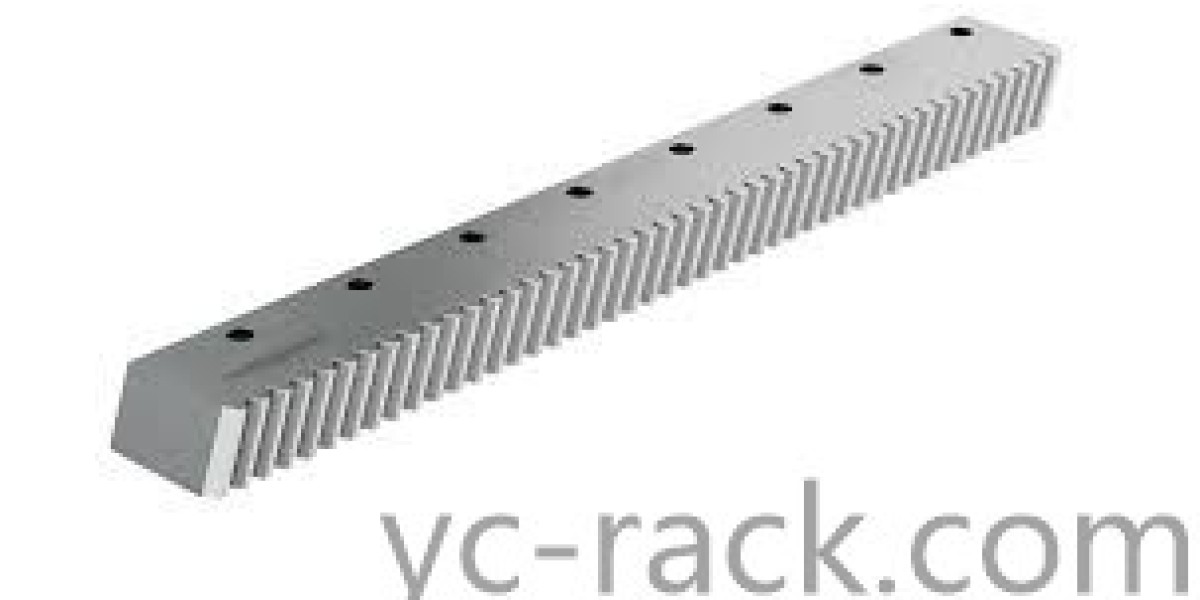

In precision linear transmission, the geometry of the tooth profile has a direct influence on engagement, load distribution, motion stability, and operating noise, which is why a properly engineered Helical Gear Rack can provide valuable advantages in systems where smooth and controlled movement is required. Zhejiang Yuchen Transmission Technology Co., Ltd. approaches rack manufacturing from an integrated engineering perspective, considering material behavior, tooth geometry, machining accuracy, and application requirements rather than treating the rack as an isolated mechanical component.
The material selected for a rack determines much of its mechanical behavior during service. Carbon steel, alloy steel, and other engineering materials can be considered according to load conditions, required hardness, machinability, and environmental exposure. Alloying elements may improve hardenability and wear resistance, while a suitable base material also provides the dimensional stability needed during machining. Zhejiang Yuchen Transmission Technology Co., Ltd. evaluates material characteristics alongside the intended transmission structure so that later manufacturing processes can be matched to the mechanical demands of the finished component.
Tooth geometry is another important factor in rack design. A helical tooth arrangement introduces an angled engagement between the rack and mating gear, allowing contact to develop progressively rather than occurring across the entire tooth width at the same instant. This characteristic can contribute to smoother force transfer and reduced impact during engagement. However, the benefit depends on accurate tooth formation and consistent alignment. Small deviations in geometry can influence contact conditions, so engineering control throughout the machining process is essential.
Manufacturing technology therefore plays a central role. Rack blanks must first be prepared with suitable dimensional consistency before tooth generation begins. Depending on the required design and production volume, cutting, milling, shaping, grinding, or other precision machining processes may be used. Each process affects surface texture, dimensional accuracy, and tooth-form consistency. Zhejiang Yuchen Transmission Technology Co., Ltd. can organize these stages as a connected manufacturing sequence, helping reduce unnecessary variation between the initial blank and the final transmission surface.
Heat treatment can further modify the functional characteristics of transmission components. Processes such as carburizing, quenching, tempering, or other controlled treatments may be selected according to the material and performance objectives. Surface hardness can help resist tooth wear, while an appropriately controlled internal structure supports the component under repeated mechanical loading. Because thermal processing can also introduce distortion, post-treatment inspection and finishing are important parts of precision rack production.
Surface finishing has a particularly strong relationship with contact behavior. A smoother and more accurately controlled tooth surface can help establish consistent engagement with the mating gear. Grinding and other finishing operations can correct small geometric deviations left by previous machining stages while improving the final surface condition. For applications involving frequent reciprocating motion, controlled surface quality can also contribute to predictable friction and wear characteristics over extended operating cycles.
Dimensional inspection is necessary throughout production rather than only at the final stage. Tooth spacing, profile accuracy, straightness, mounting dimensions, and surface conditions all influence the relationship between the rack and pinion. Modern manufacturing environments can combine conventional measurement methods with digital inspection equipment to identify deviations at different process stages. Data collected during inspection can also support process optimization, allowing manufacturers to identify recurring sources of variation and improve production consistency.
Computer-aided engineering provides another useful layer of development. Digital models allow engineers to evaluate tooth geometry, installation relationships, and potential interference before physical production. Simulation can also help analyze force transmission and structural behavior under representative operating conditions. Zhejiang Yuchen Transmission Technology Co., Ltd. can use this engineering approach to connect product design with manufacturing considerations, reducing the risk of discovering important geometric conflicts only after production has begun.
Industrial automation places additional demands on rack-and-pinion systems. Automated positioning equipment, machine tools, material-handling systems, and robotic mechanisms often require repeatable linear movement with controlled acceleration and deceleration. In these environments, transmission components must work together as a complete mechanical system. Proper alignment, mounting rigidity, lubrication strategy, and tooth engagement all influence actual operating behavior, making rack selection inseparable from the broader machine architecture.
Another consideration is noise and vibration. Irregular tooth contact can generate periodic mechanical disturbances, particularly when manufacturing errors or alignment problems accumulate across the transmission system. Accurate tooth generation and controlled finishing can help reduce these effects by creating more consistent contact conditions. The helical configuration can also support progressive engagement, which is useful when designers are seeking smoother mechanical interaction in continuous-motion equipment.
The relationship between rack design and application should therefore remain central throughout engineering development. A component intended for high-frequency positioning may require different material treatment and finishing priorities from one used in a slower industrial mechanism. Installation orientation, environmental conditions, duty cycle, mating gear characteristics, and maintenance practices can all influence the final design. Zhejiang Yuchen Transmission Technology Co., Ltd. considers these factors when developing transmission solutions intended to integrate with different types of machinery.
For manufacturers and system integrators, reliable linear transmission begins with a balanced approach to material selection, tooth geometry, machining, thermal treatment, finishing, inspection, and application engineering. When these elements are coordinated, a Helical Gear Rack can become an effective part of a controlled rack-and-pinion system, supporting smooth force transmission and repeatable linear movement. Further product and engineering information is available from Zhejiang Yuchen Transmission Technology Co., Ltd. at https://www.yc-rack.com/product/spur-gear-rack/.